


The US Securities and Exchange Commission is reportedly making an “innovation exemption” for blockchain-based tokenized trading of public companies, even those that don’t consent to the third-party tokens tracking their share prices.
Bloomberg reported on Monday that the exemption could come as early as this week, expanding the trading of public companies beyond traditional stock exchanges to decentralized crypto platforms.
The SEC reportedly spoke with “hundreds of market participants” for feedback on how best to tailor the rules for tokenized trading and proposed that third-party tokens carry the same benefits as common stock, such as voting rights and dividends, or risk being delisted.
Details haven’t been finalized and could change before the exemption is made, Bloomberg reported, citing people familiar with the matter. SEC Commissioner Hester Peirce led the push for tokenized stock trading to receive an innovation exemption, the sources said.

Blockchain-based tokenization has attracted growing interest from Wall Street firms over the past few years, as it’s seen as offering potentially greater efficiencies for trading and settlement than traditional systems.
The New York Stock Exchange’s parent, Intercontinental Exchange, said in January that it would launch a tokenization platform for 24/7 trading and settlement of stocks and exchange-traded funds using a blockchain post-trade system, marking one of the biggest developments in the tokenization space to date.
Source: Nate Geraci
Bullish, the crypto exchange led by former NYSE president Tom Farley, also strengthened its tokenization capabilities earlier this month with its $4.2 billion acquisition of transfer agent platform Equiniti.
Backers of tokenized stock trading have also said the technology can promote financial inclusion by enabling individuals without access to US markets or traditional brokerage accounts to gain exposure to public companies including Nvidia (NVDA), Google (GOOGL) and Tesla (TSLA).
Related: Kraken parent Payward sees revenue surge as tokenization expands
Despite the expected exemption, some SEC officials do not support the decision to allow tokenized stock trading, according to the sources.
Cointelegraph reached out to the SEC for comment but did not receive an immediate response.
Securitize president pushes back against exemption
Meanwhile, Brett Redfearn, president of one of the biggest crypto-native tokenization platforms, Securitize, expressed concerns over the SEC’s expected exemption, arguing that enabling third parties to tokenize stock “without an issuer at the table” could lead to fragmentation issues.
It could leave investors less certain over what their shares are worth, Redfearn said.
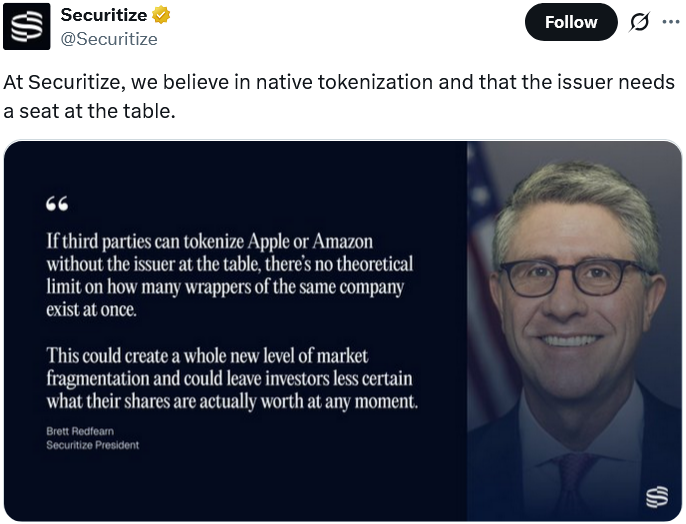
Source: Securitize
Tokenized trading has also expanded into the pre-IPO space, enabling investors to gain exposure to sought-after private companies before they go public.
However, some of these companies, including OpenAI and Anthropic, have opposed unauthorized tokenized stocks tracking their valuations.
The SEC’s tokenization move comes after the Senate Banking Committee advanced the CLARITY Act on Thursday, setting it up for a full Senate floor vote next month.
Several industry pundits, including “Shark Tank” investor Kevin O’Leary, have said Wall Street firms won’t fully embrace tokenization unless there is a framework like the CLARITY Act in place and that issues over ownership are ironed out.
Magazine: eToro founder timed Bitcoin top perfectly due to belief in 4 year cycles

 Bitcoin
  Ethereum
  Tether
  BNB
BNB  XRP
XRP  USDC
USDC  Solana
  TRON
TRON  Lido Staked Ether
  Figure Heloc
Be the first to comment